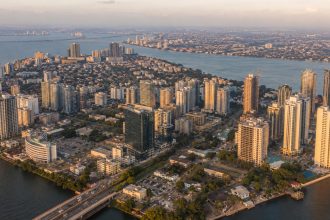
Lagos, Nigeria — May 2026
In Mushin, a tenant watched her annual rent climb from N800,000 to N1.5 million — an increase of 87.5%. In Akute in Ogun State, a resident saw his rent rise from N320,000 to N650,000 within two years — a jump of 103%. In Abuja’s Nyanya district, a tenant’s rent moved from N400,000 to N750,000 — another 87.5% increase. And in Port Harcourt, a three-bedroom apartment that rented for N500,000 now commands N800,000. Across Nigeria’s major cities, the same story is playing out — rents are rising sharply and persistently, household incomes are not keeping pace, and the gap between what tenants can afford and what landlords are charging is widening at a rate that is placing millions of Nigerians under severe financial pressure, according to reporting by Nairametrics published on 15 May 2026.
The divergence in perspectives between landlords and tenants is sharp and has reignited a national debate about whether Lagos’s rent increases reflect legitimate market fundamentals or a failure of governance to protect the country’s most economically vulnerable households. The answer, based on the accounts of landlords, property managers, and agents speaking to Nairametrics, is that both are true simultaneously — the structural pressures driving rent increases are real and documented, but so is the scale of the affordability crisis they are generating for Nigerian families whose incomes have not moved at anything close to the same pace.

What Landlords and Agents Say: Structural Forces, Not Opportunism
Temidayo Ademosu, CEO of Arrowhead Homes and Properties — which manages properties in Ogba and the Chevron axis of Lekki — told Nairametrics that rent increases are largely driven by inflation and rising cost of living, and that landlords face the same economic pressures as everyone else across the broader economy. “Rent increases have become necessary because the cost of living has risen across the board, and landlords have to adjust in line with the prevailing economic realities,” he said. Ademosu added that rent reviews are typically tied to tenancy agreements, with increases implemented after an agreed cycle — and that most tenants negotiate rather than relocate when rents are raised, largely because moving attracts additional costs including agency fees, legal charges, and caution deposits.
Mr Omoniyi Sunday Abiodun, CEO of With God Properties Management, who manages between 30 and 40 residential properties in the Maya and Adamo axis of Ikorodu, said demand pressure plays a key role alongside supply constraints. Where housing demand is strong and alternatives are limited, landlords are more likely to adjust rents upward within shorter cycles — and comparable options within similar budgets are often scarce, meaning tenants remain even after rent reviews. Rising construction material costs — particularly cement — have also increased the cost of delivering new housing units, feeding directly into higher rents for existing stock as the replacement cost of that stock rises, he told Nairametrics.
Temple Ugwu, Lead Partner at Blumeen Partners, pointed to a dimension of the crisis that is often overlooked in domestic policy discussions: the role of diaspora landlords benchmarking returns against foreign currency values. “I have a property in my portfolio whose landlord is based in New York. He bought it over six years ago, and when he compares the rent he expected in dollars at the time with what he receives now, the returns don’t match up due to currency fluctuations. What was once a viable return has been eroded over time, and rent adjustments become necessary to keep the investment sustainable,” he told Nairametrics. A Nigerian property owner based abroad confirmed the same dynamic: he acquired a Lagos property when $1 exchanged at approximately N300, but by 2026, the rate had risen to approximately N1,400 — meaning the real dollar-equivalent return on his investment had collapsed even as nominal naira rents appeared to rise. For the tenant, the increase is unaffordable. For the diaspora landlord, it is barely adequate.
What Tenants Experience: Trapped, Unable to Move
The on-the-ground reality for tenants is one of being structurally trapped. Relocation carries costs — agency fees, legal charges, caution deposits, and the physical cost of moving — that make staying in place financially rational even when a landlord raises the rent significantly. This dynamic gives landlords considerable pricing power in a market where new supply is chronically inadequate and vacancy rates in affordable rental segments are effectively zero.
Abosede Sanya in Mushin Olosha said her rent rose by 87.5% — from N800,000 to N1.5 million per year. Despite the strain on her household budget, she stayed. “I stayed because other apartments now charge similar amounts,” she told Nairametrics, adding that relocation would attract agency and legal fees she could not afford. Michael Gbenga in Akute, Ogun State, experienced a 103% increase — from N320,000 to N650,000 within two years — and reached the same conclusion. “I don’t plan to move yet because other houses are either unavailable or overpriced,” he said. In Abuja’s Nyanya district, Opeyemi Toriola saw his rent rise 87.5% to N750,000, and noted: “Even on the outskirts, you can’t get a similar place below N1.2 million now.” In Port Harcourt, Ovunda Wodi reported a 60% rent increase on his three-bedroom apartment in Rumuokoro — from N500,000 to N800,000 — under a new tenancy agreement that allows rent reviews after two years.

The pattern across these accounts is consistent: tenants are not choosing to stay because they are comfortable — they are staying because the alternative is worse. The rental housing market in Lagos, Abuja, and Port Harcourt is functioning not as a competitive market where tenants have choice, but as a constrained market where landlords hold structural pricing power and tenants absorb increases they cannot negotiate away.
The Structural Cause: A Housing Deficit Decades in the Making
The immediate trigger for each individual rent increase varies — inflation, currency depreciation, maintenance costs, neighbourhood improvement, or a new tenancy cycle. But the underlying cause of Nigeria’s rental housing crisis is structural and long-standing: the country has not built enough homes to house its rapidly urbanising population, and it is not building enough now to close that gap.
Nigeria faces a housing deficit that the National Housing Data Technical Committee placed at 14.925 million units in its early 2026 report — the first empirically derived figure using national census and household survey data. Separately, the Federal Government has acknowledged that 15.2 million existing housing units are structurally inadequate and require upgrading or replacement, according to the then-Minister of Housing and Urban Development, Arc Ahmed Musa Dangiwa. To close the supply gap, Nigeria needs approximately 550,000 new housing units annually over the next decade — at a cost of roughly N5.5 trillion per year. Current delivery is a fraction of that figure. The gap between what is needed and what is being built is the single most powerful driver of rent inflation in Lagos and every other Nigerian city, and it cannot be resolved by any number of individual landlord-tenant negotiations.
The Government Response: Renewed Hope Estates and Its Limitations
The Federal Government is rolling out the Renewed Hope Estates and Cities programme as its primary response to the housing crisis. Renewed Hope Cities are PPP-driven projects across the six geopolitical zones and the FCT, with one-bedroom units priced at approximately N22 million. Renewed Hope Estates are smaller government-funded clusters of approximately 250 units each, priced between N8 million and N9 million. In April 2026, President Bola Tinubu also swore in Dr Muttaqha Rabe Darma as the new Minister of Housing and Urban Development, signalling a renewed political focus on the sector under a fresh ministerial appointment, according to Nairametrics reporting on the appointment.
The limitations of this response are significant. The pricing of Renewed Hope units — N8 million for a one-bedroom in a Renewed Hope Estate, N22 million in a Renewed Hope City — puts them well beyond the reach of the low-income tenant households experiencing the most acute rent pressure. A family currently paying N650,000 per year in rent in Akute does not have N8 million in cash or access to the mortgage financing required to purchase a government-developed unit. The Housing Development Advocacy Network (HDAN) has called for stronger mortgage laws, housing finance guarantees, tax incentives, VAT reliefs, expanded housing finance institutions, and wider adoption of rent-to-own and cooperative housing models as complementary mechanisms — none of which have yet been operationalised at scale, according to Nairametrics’ coverage of HDAN’s advocacy.
The PropTech Layer: GIS Mapping and Digital Transparency
On 23 May 2026 — two days ago — Lagos State also announced that its ongoing GIS mapping and house numbering initiatives are expected to strengthen PropTech adoption across the rental sector, according to Nairametrics reporting on comments from industry stakeholder Igbinoba. A functioning digital property registry — with accurate geolocation, ownership records, and rental transaction histories — would improve market transparency in a sector where information asymmetry currently favours landlords. Tenants negotiating renewals have no independent access to comparable rental data, no visibility into landlord cost structures, and no mechanism for disputing increases beyond the threat of leaving. Digital rental platforms and GIS-enabled market data represent the early infrastructure of a more transparent and efficient rental market — but they remain in early stages and their impact on rental affordability will take years to materialise.
| Location | Previous Rent | New Rent | Increase |
|---|---|---|---|
| Mushin Olosha, Lagos | N800,000/yr | N1,500,000/yr | +87.5% |
| Igbogbo, Ikorodu | N700,000/yr | N1,050,000/yr | +50% |
| Akute, Ogun State | N320,000/yr | N650,000/yr | +103% |
| Nyanya, Abuja FCT | N400,000/yr | N750,000/yr | +87.5% |
| Rumuokoro, Port Harcourt | N500,000/yr | N800,000/yr | +60% |
| Nigeria housing deficit (2026) | 14.925 million units (National Housing Data Technical Committee, 2026) | ||
| Structurally inadequate stock | 15.2 million units (Federal Government, Ministry of Housing) | ||
| Annual supply needed | 550,000 units/year at ~N5.5 trillion/year to close deficit over 10 years (Federal Government estimate) | ||
What this means for African property investors and developers: Nigeria’s rental housing crisis is simultaneously a humanitarian emergency and one of the largest untapped investment opportunities on the African continent. A market with a verified deficit of 14.925 million units, 550,000 units of annual unmet demand, a government unable to deliver supply at scale, and urban populations growing at 4–5% annually is a market in which well-structured residential development — at genuinely affordable price points, with innovative financing mechanisms — can generate strong risk-adjusted returns over a long investment horizon. The Renewed Hope programme is moving, but its pricing puts it out of reach of the most urgent demand. The private sector opportunity is in the gap below N8 million per unit — the segment where Kenya’s Boma Yangu rent-to-own model, Rwanda’s Rugarama Park Estate approach, and Nigeria’s own microfinance-backed cooperative housing frameworks provide the most instructive precedents. Nigeria’s rental crisis is not a failure of the market — it is a failure of supply. And supply failures at this scale are, historically, where the most significant property investment opportunities are eventually found.
Sources
- Nairametrics — Why Lagos landlords, agents continue to increase rents, 15 May 2026
- Nairametrics — Lagos GIS mapping, house numbering to boost PropTech adoption, 23 May 2026
- Nairametrics — Tinubu swears in Muttaqha Rabe Darma as Housing Minister, 24 April 2026
- Nairametrics — HDAN urges stronger mortgage laws to cut Nigeria’s housing deficit, April 2026
- Nairametrics — FG says 15.2 million housing units in Nigeria are structurally inadequate, December 2025
- The Guardian Nigeria — Beyond 14.9M housing deficit: data clarity and delivery remains crucial, 2026
Related Articles
- Nigeria’s $2 Billion D-VIBE Project to Deploy 90,000km of Fibre Nationwide
- City Walk Abuja: Benoy’s 250-Hectare Mixed-Use Masterplan and Africa’s Tallest Tower
- Inside Kenya’s Kibera Soweto East Affordable Housing Project — A Blueprint for Africa
- Rwanda’s Real Estate Sector Drives $2.62 Billion Investment Surge
- Residential Property Projects Across Africa
Disclaimer
This article is for informational and editorial purposes only and does not constitute financial, investment, legal, or property advice. Readers should conduct their own due diligence and seek independent professional advice before making any investment or property-related decision.
Property News Africa — Editorial Team
Property News Africa is the continent’s dedicated source for real estate project news, market analysis, and investment intelligence. Research assisted by AI. All sources verified by the editorial team.
© 2026 Property News Africa. All rights reserved. | propertynews.africa