


Cairo & New Administrative Capital, Egypt — May 2026
No property story on the African continent comes close to Egypt’s New Administrative Capital in scale, ambition, or sheer audacity. Built from scratch on desert land 45 kilometres east of Cairo, at an estimated cost of $58 billion, the NAC is the largest single urban development project in Africa’s history — a city designed to house 6.5 million people, built to relieve Cairo’s chronic congestion, and now, in 2026, transitioning from construction site to functioning capital. Government ministries have relocated. Parliament is operational. 48,000 government employees are working there daily, many arriving via the Electric Train connecting the new city to eastern Cairo. Africa’s tallest building — the Iconic Tower at 393.8 metres — was completed in 2024 and is now fully operational. International universities are open. Foreign embassies are establishing presence. And Egypt’s residential property market, supercharged by currency devaluation, infrastructure investment, and structural undersupply, recorded house price growth of 20–30% in 2025, according to Sands of Wealth’s early 2026 price forecast analysis. The question is no longer whether Egypt’s property market is real — it is whether investors can move fast enough to capture the current window.
The New Administrative Capital: What Has Been Built
The NAC covers 170,000 acres and is divided into distinct districts — government, diplomatic, residential, commercial, medical, educational, and cultural zones — each built to international design and infrastructure standards and linked by a smart city management system. The Government District contains 10 ministerial complexes housing 34 ministries, the Cabinet Presidency building, the Parliament building, and a foreign embassy zone. The Egyptian Parliament formally relocated its operations to the NAC, and the presidential palace has been established in the city. The government relocation from Cairo has been described as the largest planned transfer of state functions in Egypt’s modern history, according to Encyclopaedia Britannica’s NAC entry.
The Central Business District (CBD) is the city’s commercial centrepiece — a cluster of more than 20 skyscrapers anchored by the Iconic Tower, which at 393.8 metres is Africa’s tallest building, completed in 2024 and constructed by China State Construction Engineering Corporation (CSCEC). The CBD is already attracting major Egyptian and international banks, financial institutions, and corporate headquarters — drawn by the combination of modern Grade A office stock, government co-location, and a regulatory environment designed to make the NAC Egypt’s primary commercial address, according to The Middle East Observer.
The city’s cultural and religious landmarks are already established. The Cathedral of the Nativity of Christ — the largest cathedral in the Middle East — was inaugurated in 2019. The Misr Mosque (Egypt Grand Mosque) — one of the largest mosques in Africa — was inaugurated in 2023. Both sit within the city’s civic core as deliberate symbols of Egypt’s message of national coexistence and religious harmony. The city also hosts several international universities and a new national sports stadium — Misr Stadium, the largest in the region — which became operational in early 2024, according to Global Property Guide’s Egypt residential market analysis.
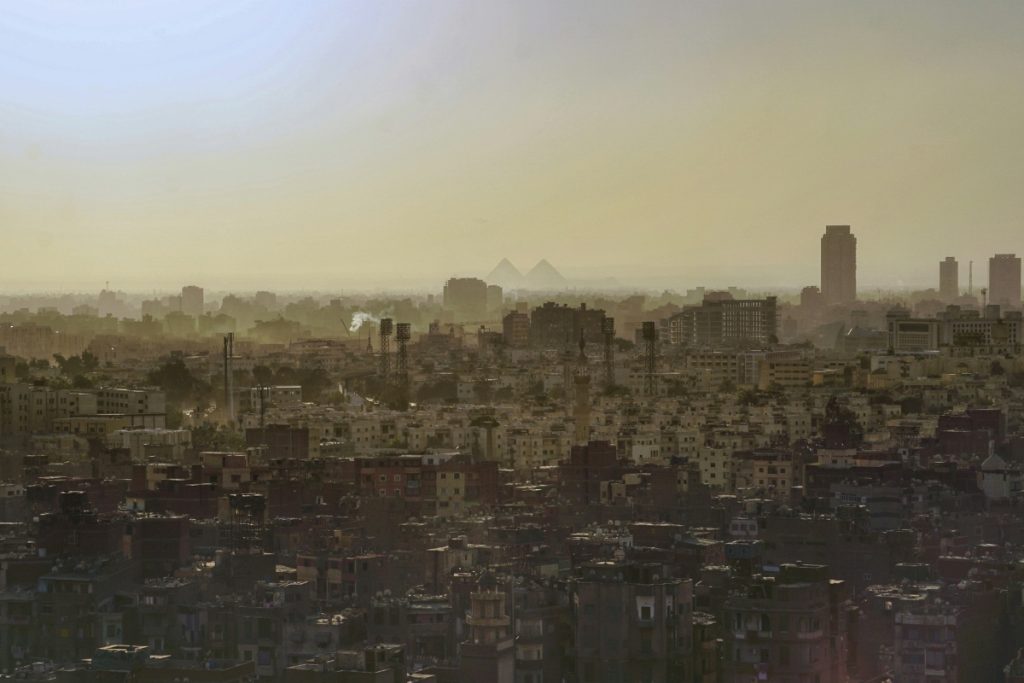
The Residential Market: Where People Are Buying
Egypt’s residential property market has delivered some of the strongest nominal price growth of any African country over the past three years — a function of structural undersupply, high inflation, currency devaluation making real assets attractive relative to cash holdings, and accelerating demand from a young, urbanising population. In New Cairo’s Fifth Settlement, average apartment prices reached EGP 61,550 (approximately USD $1,320) per square metre in December 2025 — a 157% year-on-year increase in nominal terms — while villa prices surged 287% to an average of EGP 97,000 per square metre, according to Aqarmap data cited in Global Property Guide’s Egypt residential analysis. In real terms (adjusted for Egypt’s high inflation), price growth was more moderate — but the direction is consistent.
Within the NAC itself, the most active residential districts are R7 and R8 — the premium zones closest to the Government District, the Green River, and the CBD. In Q3 2025, approximately 7,500 new residential units were delivered in the NAC’s R7 district alone, as developers began the phased handover process to buyers, bringing Cairo’s total residential stock to approximately 317,000 units by end of Q3 2025, according to JLL data cited by Global Property Guide. Resale units in R7 and R8 currently trade at EGP 20,000 to 30,000 per square metre — entry-level by NAC standards but significantly below the pricing of equivalent newer-phase developments, making them the current sweet spot for investors seeking capital gains as the city’s livability ecosystem matures, according to Sands of Wealth’s Egypt area guide.
Beyond the NAC, Egypt’s most active residential investment markets in 2026 are Sheikh Zayed and New Zayed in West Cairo — currently the most expensive locations by price per square metre — and Mostakbal City, an emerging node between New Cairo and the NAC that benefits from proximity to both gravity centres while offering lower entry prices. The North Coast along the Mediterranean continues to attract high-net-worth buyers seeking second homes and resort investment, with the Sidi Abdel Rahman corridor identified by analysts as the most likely beneficiary of continued price appreciation through 2026 and 2027, according to Sands of Wealth.
Commercial and Office Market: Grade A Demand Accelerating
Cairo’s commercial real estate market is undergoing a structural transformation driven directly by the NAC. The CBD’s tower cluster is absorbing demand from government-linked institutions, multinational banks, and large Egyptian corporations that require proximity to the relocated government apparatus. Vacancy rates in the CBD’s Grade A towers remain significantly below the Cairo metropolitan average, as the supply of truly premium office space in the new city remains constrained relative to the pace of corporate relocations. Cairo’s total office stock reached approximately 1.1 million square metres of Grade A space in 2025, according to JLL’s Cairo office market data. Rental growth in the CBD is expected to outperform the wider Cairo office market through 2026 as occupancy consolidates and further institutional tenants commit to the new city, according to Realting’s Egypt investment guide for 2026.
Foreign Ownership: What Investors Need to Know
Egypt permits foreign property ownership under a clear but bounded legal framework. Foreigners may own a maximum of two properties, each up to 4,000 square metres, without requiring a special exemption. Agricultural land cannot be purchased by foreigners. In South Sinai — which includes Sharm El-Sheikh and Ras Mohamed — a 99-year leasehold applies rather than freehold title. Desert land is subject to a separate special regime. In the NAC itself, new developments by major developers including City Edge Developments (a government-backed joint venture between the New Urban Communities Authority and the Housing and Development Bank) and large private developers are fully accessible to foreign buyers under standard ownership rules, according to Realting’s 2026 Egypt investor guide.
Most transactions in the NAC are structured as developer instalment plans rather than bank mortgages — a product of Egypt’s historically high interest rates (the Central Bank of Egypt’s benchmark overnight deposit rate sits at approximately 25–27% as of early 2026, with gradual cuts expected as inflation moderates). Instalment plans of up to 10 years are offered by major developers, with cash purchase prices in the NAC ranging from approximately $550 to $800 per square metre depending on developer, finish level, and location, according to investor analysis by The Wandering Investor. Among affluent international buyers, 17% plan to purchase property in Egypt in 2026, with another 20% considering a purchase within the next two to three years, according to Realting.
The Investment Case: Risks and Opportunities
The NAC investment case rests on a specific thesis: that 2026 is the inflection year at which the city transitions from speculative pre-construction play to an asset underpinned by real occupancy, real government demand, and real commercial activity. With 48,000 government employees already working in the city, parliament operational, banks establishing headquarters, and international universities and hospitals coming online, the demand base is no longer abstract — it is documented and growing. However, several genuine risks deserve acknowledgment.
The affordability gap is significant: current NAC residential prices are out of reach for mid-level government employees, who earn an average of approximately USD $4,800 annually — meaning the city’s workforce commutes from Cairo rather than living in the NAC itself. This limits organic residential demand in the near term and keeps rental yields lower than in more liquid Cairo submarkets. Liquidity risk also applies: the NAC’s resale market is still forming, and exit timelines are longer than in established Cairo districts. Currency risk for USD-based investors is material in an environment where the Egyptian pound has experienced significant devaluation. And developer risk — always relevant in Egypt’s pre-construction market — requires careful vetting of track records, land ownership status, and contract terms before commitment, according to Realting. For investors with a 5–10 year time horizon, however, Egypt’s combination of structural undersupply, government-backed infrastructure, strong nominal price growth, and an improving macroeconomic environment makes it one of the most compelling country-level property stories on the continent in 2026.
| Indicator | Detail |
|---|---|
| NAC total area | 170,000 acres — 45km east of Cairo, 100km from the Suez Canal |
| Planned population | 6.5 million (target); 1.1 million residential units planned across 21 districts |
| Estimated total cost | USD $58 billion (Phase 1: ~USD $45 billion) |
| Government workforce (2026) | 48,000 employees relocated; 34 ministries; parliament operational; embassies establishing |
| Iconic Tower | 393.8 metres — Africa’s tallest building; completed 2024; built by CSCEC (China) |
| Residential price growth (2025) | 20–30% nationally; New Cairo Fifth Settlement apartments +157% nominal year-on-year |
| NAC residential entry price | ~$550–800/m² (cash); R7/R8 resale from EGP 20,000–30,000/m² |
| Q3 2025 residential completions | 7,500 units delivered in NAC R7 district (JLL); Cairo total stock ~317,000 units |
| Foreign ownership rules | Max 2 properties, each up to 4,000m²; no agricultural land; 99-year leasehold in S. Sinai |
| Developer instalment plans | Up to 10 years — primary transaction structure (traditional mortgages uncommon at 25%+ rates) |
| International buyer interest | 17% of affluent international buyers plan to purchase in Egypt in 2026 (Realting) |
What this means for African property investors: Egypt is not a market for the impatient or the underprepared — but for investors with a clear strategy, a credible local partner, and a 5–10 year time horizon, the New Administrative Capital represents one of the most compelling property opportunities on the continent. The transition from construction to occupancy is the defining event of 2026: a city that was, until recently, largely empty of people is now filling with government workers, university students, hospital staff, and corporate employees at a pace that is fundamentally changing the demand profile of the asset. Nominal price growth of 20–30% in 2025 reflects the scale of structural undersupply and the depreciation of the Egyptian pound — real returns for USD-based investors were more modest but the direction is clear. For property investors tracking Africa’s emerging megacities, Egypt’s New Administrative Capital is the continent’s most important single urban development to understand. It is no longer a future story. It is happening now.
Sources
- Global Property Guide — Egypt Residential Property Market Analysis 2026, including JLL Q3 2025 data
- Sands of Wealth — Egypt Property Price Forecasts 2026: Short and Long-Term Analysis
- Sands of Wealth — Best Areas to Buy Property in Egypt 2026
- Realting — Egypt Real Estate Investment 2026: Prices, Rental Yield, Taxes and Foreign Ownership
- Encyclopaedia Britannica — New Administrative Capital, Egypt: Overview and Development
- The Middle East Observer — Egypt Officially Rebrands Its Administrative Megaproject as The New Capital, November 2025
- Sonna — Egypt’s New Administrative Capital: Ambitious, Smart and Underway, October 2025
- The Wandering Investor — Investing in Real Estate in Egypt’s New Administrative Capital: On-the-Ground Analysis
- Elbayt — Guide to Investing in Egypt’s New Real Estate Projects 2026
Related Articles
- The Nairobi Declaration: What Africa Forward Summit 2026 Means for the Continent’s Property Markets
- City Walk Abuja: Benoy’s 250-Hectare Mixed-Use Masterplan and Africa’s Tallest Tower
- Project Feature: Kigali Innovation City
- Emerging Real Estate Hotspots in Africa — 2025 Outlook
- All Country Profiles — Property News Africa
Disclaimer
This article is for informational and editorial purposes only and does not constitute financial, investment, legal, or property advice. Readers should conduct their own due diligence and seek independent professional advice before making any investment or property-related decision.
Property News Africa — Editorial Team
Property News Africa is the continent’s dedicated source for real estate project news, market analysis, and investment intelligence. Research assisted by AI. All sources verified by the editorial team.
© 2026 Property News Africa. All rights reserved. | propertynews.africa


